
Your gums bled when you brushed, and now you are trying to work out whether that matters. It might be the mildest and reversible form of gum disease, or it might be the kind that has already cost you bone. The honest answer is that you can’t tell from the outside, and neither can anyone else without measuring.
Table of Contents
What Gum Disease Actually Is
It is not one condition. The CDC uses it as a broad term for inflammation and infection of the gum and bone that support the teeth. Two forms matter to you.
Gingivitis is the mildest. It makes the gums red, swollen and prone to bleeding, and the AAP notes there is usually little or no discomfort at that stage.
Periodontitis is what gingivitis can turn into. Plaque spreads and grows below the gum line, and the toxins the bacteria produce irritate the gums and set off a chronic inflammatory response in which the body essentially turns on itself. Gums separate from the teeth, forming pockets that can become infected, and as it progresses those pockets deepen and more gum tissue and bone are destroyed.
Plaque is the sticky, colorless film that forms constantly on teeth. Left alone it hardens into tartar, which only a professional cleaning can remove.
The Part That Catches People Out: It Is Often Silent
The AAP puts it in one sentence: gum disease is often silent, meaning symptoms may not appear until the advanced stages. The ADA says the same from the other direction, that because gum disease is usually painless you may not know you have it.
The signs worth a call, from the AAP’s own list:
- red, swollen or tender gums, or other pain in your mouth
- bleeding while brushing, flossing or eating hard food
- gums receding or pulling away from the teeth
- loose or separating teeth
- a change in how your teeth fit together when you bite
- pus between the gums and teeth
- persistent bad breath
None of that tells you which form you’ve got or how far it has gone. That takes an exam.
The Stages of Gum Disease, and What They Actually Mean
Periodontitis is not staged the way it is usually described, as four stages running from “early” to “advanced”.
Since the 2017 World Workshop, co-sponsored by the AAP, periodontitis is typically classified by stage and grade. There are four stages, from the least severe Stage I to the most severe Stage IV, and three grades, A to C. Staging classifies the severity and extent of the damage based on the measurable amount of destroyed or damaged tissue. Grading indicates the rate of progression, how the disease is expected to respond to standard therapy, and its potential impact on general health. The same workshop retired “aggressive periodontitis” as a separate diagnosis.
What that means for you is simpler. There are two forms of the disease: gingivitis, which is reversible, and periodontitis, which involves bone loss and is not. Where a case of periodontitis sits within stages I to IV is something a periodontist works out from millimeter measurements and radiographs, which is why it is not a question you can answer at home.
What Raises the Risk
These are risk factors that may contribute to gum disease developing or progressing, not causes, and the AAP is careful to put it that way.
- Tobacco. The AAP says studies have shown it may be one of the most significant risk factors in the development and progression of periodontal disease. The CDC puts a number on it: about 62% of US adults aged 30 and over who currently smoke had periodontitis in 2009 to 2014.
- Genetics. Some people may be genetically susceptible, and despite diligent home care those people may be more likely to develop periodontal disease. Worth saying plainly, because this is not always a story about someone neglecting their teeth.
- Day-to-day plaque control. The ADA, the CDC and NIDCR all name poor oral hygiene among the risk factors, which is the part of this list you have the most say over.
- Diabetes, in both directions: people with diabetes are more likely to have periodontal disease, and untreated periodontitis can make chronic conditions including diabetes worse.
- Some medications, which is a reason to bring your full medication list to the exam.
- Hormonal changes in girls and women, stress, age, and clenching or grinding, which puts excess force on the supporting tissues.
Gums bleeding when you brush? Call our Everett dental office and we will take a look.
Your Dentist, or a Periodontist?
The AAP’s own answer is “both”: rather than leaving treatment to one professional, it suggests having both your general dentist and a periodontist involved. A periodontist is a dentist trained in the prevention, diagnosis and treatment of periodontal disease, with three additional years of education beyond dental school.
The AAP notes that some general dentists treat less serious cases, while many refer the more challenging ones. The AAP lists what typically prompts that referral, including a moderate or severe level of periodontal disease, a personal or family history of conditions such as heart disease, stroke or diabetes, and smoking. A referral is not bad news, it is a question of who has the training for the case in front of them.
At Icon Dental Center that decision is simple, because gum disease treatment and all periodontal surgery are done here by Dr. Betsy Mosquera, our periodontist.
How It Is Treated
If it is gingivitis, the ADA says it can usually be eliminated by a professional cleaning, followed by daily brushing and cleaning between the teeth.
If it has gone below the gum line, the first treatment is scaling and root planing. The periodontist scales beneath the gum line to remove plaque and bacterial toxins from the pockets, then smooths the tooth root so plaque and toxins are less able to stick to it.
The evidence is moderate. The ADA’s own systematic review and meta-analysis of 72 articles found, with a moderate level of certainty, an average gain in clinical attachment of about 0.5 millimeters, the measure of how much attachment between gum and tooth has been lost, and the ADA’s clinical recommendation is that it should be the initial nonsurgical treatment for periodontitis.
Two things worth knowing. Many patients do not need further treatment after scaling and root planing, but the majority will need ongoing maintenance to keep the disease under control. And these procedures have limits: when non-surgical treatment does not get the gums healthy, a periodontist may recommend surgery.
If surgery is needed, it is usually about access and about what has already been lost. Periodontal surgery covers pocket reduction, where the gum tissue is folded back so the bacteria can be removed and the tissue secured against the tooth; gum grafting, which covers a root exposed by recession and helps prevent further recession and bone loss; and regenerative procedures, where membranes, bone grafts or tissue-stimulating proteins are used to encourage the body to regenerate bone and tissue.
Can Gum Disease Be Reversed?
For gingivitis, yes. The AAP says it is reversible with professional treatment and good home care.
For periodontitis, the CDC’s sentence is the clearest one available: it cannot be reversed, but it can be slowed down and managed with professional treatment.
There is one nuance and it is worth stating exactly. The AAP says regenerative procedures can reverse some of the damage by regenerating lost bone and tissue. Some, by surgery, chosen case by case. Not all of it, and not by brushing harder.
Managed is not a consolation prize: regular examinations are how progression gets tracked.
Everett, WA
Not sure how far it has gone?
An exam and measurements are the only way to find out.
What Happens If It Is Left Alone
Periodontitis and tooth decay are the two leading causes of tooth loss, and bone loss around the affected teeth is a main feature of the disease. Eventually teeth can become loose and may fall out or need to be removed.
On the wider health question, the honest answer is that researchers have found associations, and that the authorities that have looked at it stop short of saying one causes the other. The ADA: research is ongoing, and while a link is not conclusive, some studies indicate that severe gum disease may be associated with other conditions. The AAP: several studies have shown a link, while a causal relationship has not been conclusively established. The American Heart Association, in a scientific statement updated in December 2025: despite the growing evidence, causality has not been established.
That cuts both ways. It is a reason to treat gum disease, and it is not evidence that treating your gums will fix your heart.
Keeping It From Coming Back
The basics do most of the work: brushing twice a day with a fluoride toothpaste for two minutes, cleaning between the teeth daily, where the ADA notes that adults who more often reported cleaning between their teeth were less likely to have periodontitis, and not using tobacco.
After treatment, the interval is not a fixed rule. The AAP’s position is that your periodontist works with you to create a maintenance schedule depending on how advanced the disease was and how it responds. There is no universal number: a Cochrane review found no trials comparing one maintenance interval with another.
Gum Disease Treatment at Icon Dental Center
Gum disease treatment and all periodontal surgery here are done by Dr. Betsy Mosquera, our periodontist.
What treatment costs depends on how far the disease has progressed, how many areas of the mouth need treating and what your plan covers. CareCredit is available, which spreads the cost over monthly payments. We are in network with Delta Dental/WDS, Regence, Premera, Aetna and Cigna, and out of network with MetLife, United and Concordia. Call the office and we will go through yours before you decide on anything.
Common Questions
What does the periodontist actually measure?
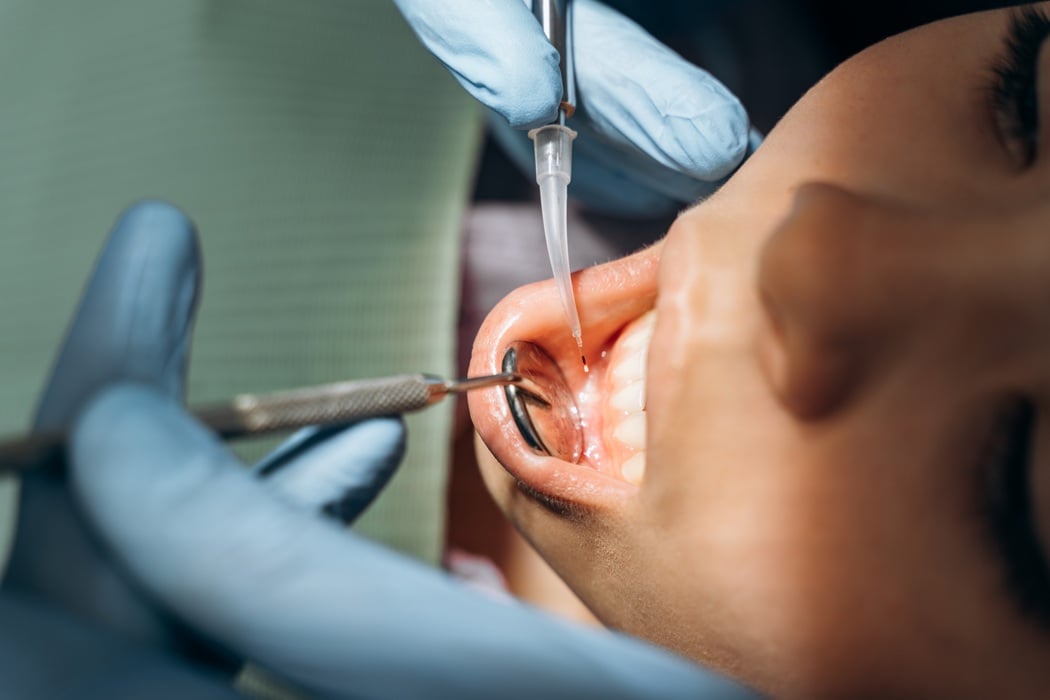
The gums are examined for inflammation, bleeding and recession, and a tiny ruler called a probe is used to measure the spaces around the teeth. A first visit with a periodontist usually also covers your full medical and dental history, because both affect the gums.
Is gum disease just part of getting older?
Older people have the highest rates, and the AAP cites CDC data that over 70% of Americans aged 65 and over have some form of gum disease. It is not inevitable: the AAP says that with the right home care and regular visits, periodontal disease can be preventable.
What else does a periodontist do?
Most of a periodontist’s time goes on diagnosing and treating gum disease, but the AAP notes they also place dental implants when natural teeth cannot be saved. Here, Dr. Mosquera places every implant as well.
Is periodontal maintenance the same as a regular cleaning?
No. Alongside the components of a typical recall examination, it includes periodontal evaluation and scaling and root planing where indicated.